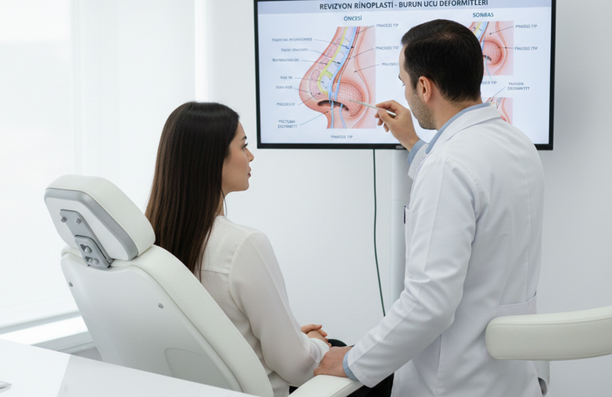

Nose aesthetics and functionality are critical factors that directly affect facial appearance. In this context, saddle nose deformity is a condition characterized by a collapsed nasal bridge and loss of cartilage support structure. This condition can create various aesthetic and functional difficulties; the tip of the nose may droop, the facial profile may change, and in severe cases, breathing difficulties may occur. If you would like to learn more about this condition, please take a look at our content. We wish you all good health and happy reading.
What is a Saddle Nose?
Saddle nose is a structural nasal deformity characterized by a pronounced depression on the bridge of the nose and is referred to as Saddle Nose Deformity in medical literature. This deformity occurs as a result of weakening or loss of the cartilage and bone tissues supporting the nasal bridge, causing the nasal profile to take on a concave appearance resembling a saddle when viewed from the side. In this context, saddle nose is not only an aesthetic problem but can also lead to functional problems such as difficulty breathing, nasal congestion, and airway narrowing due to the deterioration of the internal support structures of the nose. Trauma, previous nose surgeries, loss of septal cartilage, infections, autoimmune diseases, substance abuse, and congenital cartilage insufficiency are among the most common causes of saddle nose deformity. Treatment for this deformity is usually surgical, involving reconstructive rhinoplasty using cartilage or bone grafts to restore support to the nasal bridge. Consequently, early evaluation and proper surgical planning are critical for successfully restoring both aesthetic appearance and respiratory function.
How Do I Know If I Have a Saddle Nose?
To understand the presence of a saddle nose deformity, one must first pay attention to the structural changes that develop in the nasal profile over time. To do this, one should note whether there is a noticeable depression on the bridge of the nose when viewed from the side, and whether there is flattening or a concave appearance on the bridge of the nose. On the other hand, in addition to visual changes, previous nose injuries, past nose surgeries, or damage to the internal cartilage tissue should not be overlooked. From a functional perspective, difficulty breathing, nasal congestion, feeling short of breath during exercise, and similar conditions should be checked.
What Causes Saddle Nose?
Saddle nose deformity occurs as a result of disruption to the integrity of the cartilage and bone structures supporting the bridge of the nose. The most common causes of this condition include nasal trauma; in particular, fractures due to impact or untreated trauma can lead to collapse of the nasal bridge support over time. Previous nasal surgeries, especially rhinoplasty procedures where excessive removal of septal cartilage or inadequate preservation of structural support occurs, are a significant risk factor for saddle nose development. Additionally, infections can contribute to the onset of deformity by causing damage to the cartilage tissue. Rarely, congenital cartilage deficiencies and substance abuse may also contribute to saddle nose formation. Ultimately, all these factors weaken the nasal bridge support, leading to the development of the characteristic depression.
How Is the Saddle Nose Diagnosed?
The diagnosis of saddle nose deformity is made through a detailed clinical evaluation and, when necessary, the use of imaging techniques. At this point, the diagnostic process begins with taking the patient’s history and inquiring about risk factors such as previous nose trauma, prior rhinoplasty surgeries, infections, autoimmune diseases, or substance use. The subsequent physical examination assesses the degree of depression on the bridge of the nose, the support of the tip of the nose, the condition of the skin and soft tissue, and the integrity of the internal structures of the nose. In this context, a profile examination is particularly important in detecting a saddle-shaped concave appearance. Functionally, the internal nasal examination evaluates breathing problems by examining the septal support, nasal valve area, and airway patency. Thus, imaging methods such as computed tomography (CT) are used in necessary cases to reveal the condition of bone and cartilage structures in detail. Ultimately, the diagnosis of saddle nose is confirmed by a comprehensive evaluation of clinical findings by a specialist physician and forms the basis for treatment planning.
Signs of Saddle Nose
Saddle nose has many different symptoms. These symptoms vary from person to person, and not every symptom is seen in every patient. Therefore, if you think you are experiencing one or more of the symptoms listed below, you should seek immediate medical attention. At this point, the symptoms of saddle nose appearance are as follows:
-
- A noticeable depression or concave (inward) appearance on the bridge of the nose
-
- A profile that resembles the shape of a saddle when viewed from the side
-
- A drooping or misshapen tip of the nose due to loss of support
-
- A feeling of structural weakness in the middle part of the nose
-
- Nasal congestion and difficulty breathing
-
- Decreased airflow due to narrowing in the nasal valve area
-
- Increased breathing difficulty during exercise
-
- A history of previous nasal trauma or rhinoplasty
-
- Functional breathing problems due to internal nasal collapse in advanced cases
What are the Stages of Saddle Nose?
There are certain stages in the formation of a saddle nose. These stages vary depending on the condition of the nose structure. If we examine these stages in detail, they are as follows:
-
- Major Saddle Nose
At this stage, the depression on the bridge of the nose is pronounced, and the nasal bone and cartilage support are severely compromised. As a result, the bridge of the nose is almost completely collapsed, and the tip and profile of the nose are significantly affected. Clinically, a deep “V” or “U” shaped deformity on the nasal bridge, drooping of the nasal tip, and functional problems, especially breathing difficulties, may be observed. At the same time, the deformity significantly distorts the facial profile from an aesthetic point of view. At this point, treatment usually requires reconstructive rhinoplasty, and nasal support is rebuilt using grafts such as septum, ear, or rib cartilage. Complete restoration of the bone and cartilage structure may be necessary.
-
- Moderate Saddle Nose
In moderate saddle nose, there is a depression on the bridge of the nose and partial loss of support. In this loss, the deformity is noticeable, but the tip of the nose is usually not seriously affected. In addition, clinical findings include mild to moderate depression on the bridge of the nose, slight drooping of the tip of the nose, and rarely mild congestion. The deformity may also be noticeable from an aesthetic perspective, but it does not completely disrupt the facial profile. Therefore, the treatment approach usually involves structural rhinoplasty or partial grafting. Support can be provided using septal cartilage or ear cartilage to achieve both aesthetic and functional correction.
-
- Minimal Saddle Nose
In a minimal saddle nose, the depression on the bridge of the nose is very slight and usually only causes aesthetic concerns. Therefore, the tip of the nose and internal structures are normal, and functional problems are rarely seen. Additionally, clinically, the depression is mostly noticeable in the side profile. As a result, the need for treatment is generally low and depends on the patient’s preference. Minimal or non-invasive interventions, such as filler injections or small cartilage grafts, can provide aesthetic correction.
How Do You Fix a Saddle Nose?
Correction of saddle nose deformity is primarily achieved through surgical or minimally invasive procedures planned according to the severity of the deformity and the patient’s nasal anatomy. In mild cases, filler injections or small cartilage grafts may be used to correct the aesthetic appearance of the depression on the nasal bridge. Moderate and severe cases usually require reconstructive rhinoplasty; in this method, grafts such as septum, ear, or rib cartilage are placed to provide support to the bridge of the nose. Thus, the stabilization of the nasal bone and cartilage structures is ensured during surgery, and the tip and bridge of the nose are reshaped. After the procedure, a splint or bandage is placed on the nose to provide support, and the initial healing process is usually completed within 1-2 weeks. As a result, full recovery, stabilization of the cartilage and bone structures, and the final appearance of the nose can take several months; complete reduction of swelling and final shaping of the nasal bridge occurs between 6 months and 1 year.
How Long Does It Take To Recover After Saddle Nose Treatment?
The recovery period following the treatment of saddle nose deformity may vary depending on the surgical technique used, the graft material employed, and the patient’s overall health condition. However, the initial recovery period after reconstructive rhinoplasty is usually completed within 1–2 weeks; during this process, swelling, bruising, and sensitivity may be noticeable, and the splint or bandages placed on the nose are removed at the end of this period. On the other hand, it may take several months for the nasal tissues to heal completely, for the cartilage and bone structures to stabilize, and for the nose to take on its final shape. It takes between 6 months and 1 year for the swelling to completely subside and for the bridge of the nose to take on its final shape. In conclusion, recovery after saddle nose treatment is a gradual process, and following the surgeon’s recommendations plays a critical role in achieving successful results, both functionally and aesthetically.
If you suffer from a saddle nose appearance, you can immediately schedule a preliminary consultation with Dr. Hasan Duygulu, who specializes in rhinoplasty surgery in Turkey.
Frequently Asked Questions
Does saddle nose deformity affect breathing?
Yes. Structural collapse of the nasal bridge can weaken the internal supporting tissues of the nose, leading to narrowing of the nasal airway and breathing difficulties.
Is saddle nose deformity congenital?
It can be both congenital and acquired. Congenital cases are rare; most cases develop later in life due to trauma, surgery, or disease.
Does saddle nose deformity correct itself?
No. As it is a structural deformity, it does not correct itself and may become more pronounced over time.
Are there degrees of saddle nose deformity?
Yes. It can be classified as mild, moderate, or severe. The treatment plan is determined based on the severity of the deformity and any accompanying functional problems.
Is Saddle Nose Deformity surgery difficult?
Yes. These surgeries require advanced surgical experience and knowledge of reconstructive rhinoplasty. Therefore, they should be performed by experienced surgeons in the field.