Pinched Nose Tip Surgery
The tip of the nose is one of the most striking areas of facial aesthetics and directly affects its expression. In particular, a nasal tip that appears wide, disorganized, or “congested” can cause the nose to be perceived as larger than it is and make facial proportions appear unbalanced. For this reason, nasal tip pinching surgery is a specialized surgical application that aims to achieve a more elegant, balanced, and natural appearance by reshaping only the cartilage structures at the nasal tip without intervening in the bone structure. If you would like to have detailed information about this flawless procedure, you can take a look at our content. We wish you all a pleasant read and healthy days.
What Is a Pinched Nasal Tip?
Pinched nose tip is generally a condition where the lower lateral cartilages (alar cartilages) forming the nasal tip lose their normal anatomical width, resulting in a collapsed and narrowed appearance. This condition creates an unnaturally thin, sharp, and compressed contour at the nasal tip; especially when viewed from the front, the nostrils appear narrowed and the tip of the nose looks as if it has been squeezed from the sides. It mostly occurs due to the excessive removal of cartilage or the failure to provide adequate structural support following aggressive rhinoplasty surgeries. However, factors such as trauma, weak cartilage structure, or scar contraction during the healing process can also cause this condition. Therefore, the pinching of the nasal tip is not only a cosmetic problem but also a functional deformity due to the loss of structural support, and in most cases, it requires revision surgery supported by structural grafts.
Causes of a Pinched Nose Tip
A pinched nasal tip can stem from both genetic structure and past surgical operations. However, there are many causes for this condition. To examine the causes of a pinched nose tip:
1. Post-Rhinoplasty (Nose Job) Complications The most common cause is excessive intervention applied to the nasal tip during surgery:
Over-resection of Cartilage: Trimming the structures known as “lower lateral cartilages” more than necessary to reduce the nasal tip causes the nasal sidewalls to lose their support.
Tight Suturing Techniques: Sutures applied too tightly to narrow the nasal tip cause the tissues to buckle inward.
Lack of Support Grafts: Failure to use cartilage reinforcements (such as batten grafts) to support the weakened cartilage structure leads to tissue contraction during the healing process.
2. Genetic and Structural Factors In some individuals, the nasal tip may appear pinched even without any prior surgery:
Weak Cartilage Structure: Inherited thin and soft alar cartilages can collapse inward due to the vacuum effect created while breathing.
Narrow Nasal Sidewalls: Anatomically very narrow or vertically positioned nasal sidewalls (ala) trigger this appearance.
3. The Aging Process
Tissue Loss: As one ages, the skin at the nasal tip thins and the cartilaginous supports weaken. This can cause the nasal tip to droop and the sides to hollow out, creating a pinched appearance.
4. Nasal Trauma
Accidents and Impacts: Severe blows to the nasal tip can lead to fractures or displacement in the cartilage structure, causing the healing tissue (scar tissue) to pull the nasal sidewalls inward.
5. Nasal Valve Collapse
Functional Impairment: A pinched nasal tip is not just an aesthetic issue but also a narrowing of the airway. For this reason, nasal valve collapse also causes a pinched nose tip.
6. Revision Surgeries
Repeat Operations: Undergoing multiple nose surgeries can impair blood circulation in the area and increase scar tissue, creating a contraction toward the midline of the nose.
Symptoms of a Pinched Nasal Tip?
A pinched nasal tip manifests itself through both visual and functional symptoms. These symptoms include:
Clothespin-Squeezed Appearance: This is the most prominent aesthetic symptom. From the outside, the nasal tip looks narrow and collapsed, as if it were being squeezed by a clothespin.
Difficulty Breathing: Since the nasal sidewalls collapse inward, the airway narrows. Difficulty is experienced especially when trying to take a deep breath through the nose.
Nasal Sidewall Adhesion While Breathing: Due to the vacuum effect created during inhalation, the nasal sidewalls (valve area) move inward, approaching each other or closing completely.
Pointiness and Sharpness at the Nasal Tip: The nasal tip loses its soft and rounded contours, taking on an excessively pointed, asymmetrical, or “V-shaped” appearance.
Hollows in the Nasal Sidewalls (Alar Retraction): Deep hollows or shadows form just above the nasal wings, where they should not normally be.
Narrowing or Deformity of the Nostrils: The nostrils may become flattened from top to bottom or narrow excessively into a vertical line.
Nasal Voice While Speaking (Nasality): Because the airway is restricted, the person’s voice may sound as if it is coming from the nasal cavity (as if the nose is congested) while speaking.
Mouth Breathing During Physical Effort: In situations requiring mild effort, such as walking or sports, the person reflexively begins to breathe through the mouth because the air coming from the nose is insufficient.
Breathing Problems From A Pinched Nasal Tip
A pinched nasal tip does not only create an aesthetic deformity; it can also lead to respiratory problems by directly affecting the internal nasal valve area, which is the narrowest part of the nasal airway. In particular, the weakening or inward collapse of the lower lateral cartilages causes the nasal sidewalls to collapse further inward due to the negative pressure effect generated during inspiration. This condition leads to airflow restriction that becomes more pronounced during deep breathing, exercise, or sleep at night. In this context, patients generally describe complaints such as unilateral or bilateral nasal congestion, a sensation of not getting enough air, a tendency toward mouth breathing, and associated dry mouth. In some cases, even if the nose appears normal from the outside, functional narrowing due to dynamic valve collapse is present. Over time, chronic mouth breathing can pave the way for secondary problems such as snoring, decreased sleep quality, and even headaches. Therefore, respiratory problems due to a pinched nasal tip are a form of nasal valve insufficiency that must be evaluated not only aesthetically but also functionally, and in most cases, must be corrected with structural support grafts.
Diagnosis of Nasal Tip Constriction
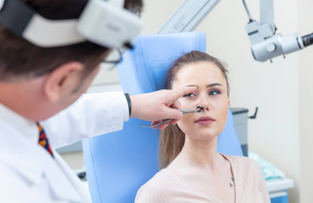
The diagnosis of a pinched nose tip is a multifaceted clinical process that requires both aesthetic evaluation and functional analysis. In this context, first, the patient’s complaints are listened to in detail; specifically, difficulty breathing, nasal congestion, and previous rhinoplasty history are questioned. Then, during the physical examination, the nasal tip projection, symmetry, support of the alar cartilages, and the shape of the nostrils are carefully examined. Typical findings include an abnormally narrow appearance of the nasal tip when viewed from the front, inward collapse at the alar margins, and the observation of dynamic collapse during inspiration.
In the functional evaluation, the narrowing in the internal nasal valve area is analyzed using the Cottle maneuver or modified valve tests; the inward collapse of the nasal sidewalls during inspiration suggests dynamic valve insufficiency. When necessary, the nasal passage is examined in detail via endoscopic examination, and accompanying factors such as septum deviation or concha hypertrophy are ruled out. Especially in patients who have undergone previous surgery, the lack of cartilage and the presence of scar tissue are evaluated through palpation.
Surgical Options for Correcting a Pinched Nose Tip
Correcting the problem in a pinched nose tip is a repair process that is both aesthetic and functional (breathing). Various interventions are applied during this process. In this context, the procedures performed are as follows:
Alar Batten Graft Application: This is the most common method. In this technique, cartilage pieces taken from another part of the body (usually the ear or rib) are placed into the collapsed sections of the nasal sidewalls. Thus, these grafts act as a “wall,” preventing the sidewalls from collapsing inward during inhalation.
Lateral Crural Grafting: The weak sections of the cartilages forming the nasal tip (lateral crura) are reinforced with cartilage supports added underneath or on top. This procedure pushes the pinched appearance outward, providing a more natural and wider form.
Lateral Crural Flip Technique: If the patient’s own cartilages are severely recurved or buckled, the surgeon cuts these cartilages, flips them over (making them convex), and sutures them back. This can help correct the structure without using additional cartilage.
Spreader Grafts: If the constriction originates from the middle vault of the nose, thin cartilage strips (spreader grafts) placed between the nasal bridge and the sidewalls widen the internal nasal valve to open the airway.
Butterfly Graft: A cartilage piece is placed just above the nasal tip, spreading out like wings to both sides. This graft pulls the nasal sidewalls upward and outward, offering an effective solution for severe collapse cases.
Revision Rhinoplasty (Reconstruction): If the constriction is a result of a previous surgical error, scar tissues are cleared, and the nasal tip anatomy is rebuilt from scratch using strong supports such as rib cartilage.
Composite Grafts: In cases where both skin and cartilage are missing (usually if excessive tissue was removed), a skin-cartilage piece taken from the ear is transplanted directly into the nasal sidewall to address the tissue loss.
Revision of Suture Techniques: Sutures applied in a previous surgery to narrow the nasal tip that were overtightened are cut to allow the tissues to relax and are refixed at a wider angle.
Rhinoplasty To Correct The Pinched Nasal Tip
Rhinoplasty is a procedure frequently performed in cases of a pinched nose. Thanks to this procedure, the nasal tip (tip plasty) is reshaped using specialized techniques; excess cartilage tissues are rearranged in a balanced manner, weak areas are reinforced with grafts, and the nasal tip projection and rotation are adjusted to be compatible with facial proportions. Furthermore, in rhinoplasty applications, a principle of support is adopted rather than just reduction; thus, both a natural appearance is achieved and the risk of collapse is minimized in the long term. As a result, while the pinched appearance at the nasal tip is eliminated through rhinoplasty, the overall expression of the face becomes more balanced and aesthetic.
Is Pinched Nose Tip Surgery Right for You?
A pinched nose tip surgery is a suitable surgical option for individuals who have problems related to the shape, drooping, width, or asymmetry of only the nasal tip, rather than the nasal bridge or hump. In fact, if your nasal tip appears low, significantly drops when you smile, looks excessively wide or bulbous, or if your nostrils appear asymmetrical; reshaping only the cartilage structures without intervening in the bone structure may be sufficient.
This operation balances the projection (the degree of forward protrusion) and rotation (the angular position) of the nasal tip by analyzing facial proportions. However, if there is a deviation on the nasal bridge, a hump, or serious functional breathing problems, nasal tip surgery alone may not be enough, and a comprehensive rhinoplasty may be planned. Therefore, the right decision should be made after a detailed examination, facial analysis, and evaluation of expectations.
Recovery After Pinched Nose Tip Surgery
The recovery process after pinched nasal tip surgery is generally more comfortable and faster compared to classic rhinoplasty because the bone structure is not intervened with; the procedure is mostly performed on the cartilage tissues. In this context, edema, slight bruising, and sensitivity may be observed at the nasal tip after surgery; swelling is prominent for the first few days, but it is usually possible to return to social life within 7–10 days. During this process, keeping the head elevated, protecting the nose from impacts, being careful with the use of glasses, and not neglecting the taping or check-ups recommended by the doctor positively affect the healing. In short, with the correct surgical technique and proper care, the results are both natural and long-lasting.
If you are suffering from a pinched nasal tip condition, you can contact Dr. Hasan Duygulu, an expert in revision rhinoplasty in Turkey.
Frequently Asked Questions
Is a pinched nasal tip only an aesthetic problem?
No. Aesthetically, it creates an artificial and narrow appearance at the nasal tip. However, it can also lead to breathing problems by narrowing the internal nasal valve area.
Will the nose become too wide after pinched nose tip surgery?
No. The goal is not to widen the nose, but to create an anatomically natural and balanced nasal tip. While correcting the excessively narrow appearance, harmony with the face is maintained.
Does every pinched nasal tip case require surgery?
Surgery is recommended if there is both aesthetic dissatisfaction and functional issues. In mild cases, the decision is made based on the patient’s expectations.
How does a pinched nose tip affect facial expression?
When the nasal tip looks excessively narrow and squeezed, the nose can take on an artificial, sharp, and sometimes “operated” look. This can create a harsh expression in the midline of the face and disrupt the natural nasal triangle.
Are pinched nasal tip and nasal tip drooping the same thing?
No. In nasal tip drooping, there is a loss of projection; in a pinched nasal tip, there is a squeezed appearance due to narrowing and collapse from the sides. However, in some patients, both problems can be seen together.
How does a pinched nose tip affect breathing?
The nasal tip cartilages are part of the internal nasal valve area. When this structure narrows, airflow can decrease, leading to a feeling of strain, especially during exercise or deep breathing.
Can a pinched nasal tip recur?
If adequate structural support is not provided, narrowing may occur again over time. For this reason, the modern approach is to shape the nasal tip by supporting it rather than just reducing it.