How to Sleep After Septoplasty
The recovery process after septoplasty is not limited only to medication use and doctor check-ups; daily life habits are also of great importance during this period. Especially the sleeping position is quite significant at this point. If you are also wondering how you should sleep after septoplasty, you can take a look at our content. We wish you all healthy days and a good read.
Why Are Sleeping Positions Important in Septoplasty Surgery?
Sleeping positions in septoplasty surgery play a critical role in terms of the comfort and safety of the recovery process. In this context, since the tissues inside the nose are edematous and sensitive after surgery, keeping the head above heart level facilitates venous return, thereby reducing swelling and minimizing the risk of bleeding. Especially during the first week, sleeping in a supine and semi-seated position prevents external pressure on the nose while helping the surgically corrected septum remain stable. On the other hand, sleeping in a side or prone position can increase pain by applying mechanical pressure to the nasal structure, create a basis for bleeding, and, although rarely, negatively affect the healing process. Furthermore, the correct position reduces the risk of involuntary movements damaging the surgical site throughout the night and ensures the patient has a more controlled recovery period. Therefore, the sleep pattern after septoplasty is of great importance not only for comfort but also for preventing complications and preserving surgical success.
How to Sleep After Septoplasty Surgery?
One of the most frequently asked questions after septoplasty surgery is how to sleep following the operation. To provide a clear answer in this context, we can examine the sleeping situation in two periods: the First 48 Hours and the First 1-Week process. You can sleep in the following manner during these mentioned periods:
First 48 Hours: The Most Critical Period
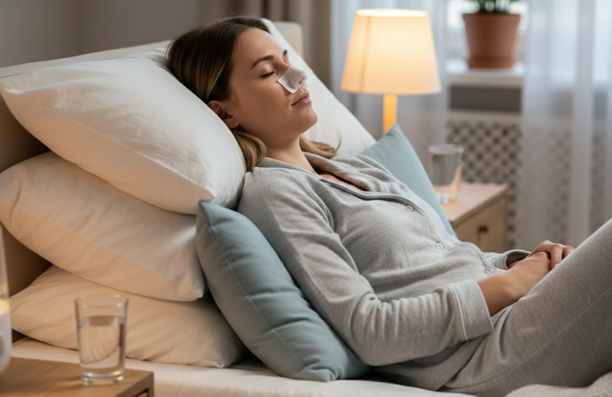
The first 48 hours after septoplasty is the period when the risk of bleeding and edema is at its highest. During this process, one must absolutely sleep in a supine and semi-seated (approximately 30–45 degrees) position. The head should be kept above heart level; for this, 2–3 pillows can be used or an adjustable bed can be preferred. On the other hand, lying on the side or prone is strictly not recommended, as it can create pressure on the nose and increase the risk of bleeding. During sleep, a neck support pillow can be used to prevent involuntary turning. Additionally, sudden head movements should be avoided, and the head position should be kept as stable as possible throughout the night.
Sleeping Position During the First Week
During the first week, the basic principle remains the same: one should continue to sleep on their back and keep the head elevated. This is the stage where edema persists and the internal nasal tissues are in the healing process. While a semi-seated position is not mandatory for this, it is recommended to keep the head slightly elevated. Transitioning to side sleeping can generally be done at the end of the first week with a doctor’s approval. However, hard pillows that could create pressure on the nose should be avoided, and the head should be prevented from sinking to the side. Sleeping in a prone position is not recommended for at least several weeks. As a result, the correct sleeping position both increases comfort and helps preserve the surgical outcome.
When Can You Switch to Side Sleeping?
The timing for switching to side sleeping after septoplasty varies depending on the patient’s recovery speed and the scope of the surgery, but it is generally possible after the first 7–10 days, following the doctor’s check-up.
Since the tissues inside the nose are edematous and sensitive during the first week, sleeping on your side can increase swelling by applying mechanical pressure to the surgical area and, rarely, increase the risk of bleeding. Additionally, it is safer to sleep on your back with your head elevated in the early period so that the septum remains stable in its new position. Nevertheless, hard pillows that would create direct pressure on the nose should be avoided, and the head should continue to be kept slightly elevated. Especially for patients with tampons, splints, or silicone supports, the side-sleeping period may be delayed a bit longer. Therefore, the most accurate timing should be determined according to the recommendation of the surgeon who performed the operation.
Benefits of the Correct Sleeping Position After Septoplasty
Maintaining the correct sleeping position after septoplasty surgery provides benefits in many aspects. In this context, the mentioned benefits are as follows:
Faster Reduction of Edema and Swelling: Keeping the head above heart level facilitates the downward drainage of blood and lymphatic fluid in the nasal area. In this way, post-operative facial swelling and bruising are minimized.
Reduced Risk of Bleeding: By ensuring that the vascular pressure in the nasal area remains low, it prevents an increase in leakage-type bleeding or the triggering of new bleeding after surgery.
Reduced Nasal Congestion and Easier Breathing: In a horizontal position, the nasal turbinates (conchae) swell more. When sleeping with the head elevated, the fullness in the internal nasal mucosa decreases, which provides more comfortable breathing despite the tampons.
Preservation of Nasal Axis and Shape: Sleeping in a supine position prevents the nose from being subjected to pressure by contacting the pillow or bed. This eliminates the risk of asymmetry, especially after septoplasty where cartilages are reshaped.
Minimizing Infection Risk: The correct position helps internal nasal discharge drain healthily towards the nasal passage or outwards. Therefore, preventing fluid accumulation blocks the formation of a suitable environment for bacterial growth.
Higher Quality and Uninterrupted Sleep: When nasal congestion and the feeling of pressure decrease, the patient feels less of the restlessness common in the first days of surgery. Transitioning to the deep sleep the body needs for healing becomes easier.
Safety of Sutures and Tampons: Friction or involuntary hand movements that may occur during side sleeping can damage the sutures. Therefore, a stable supine position prevents the displacement of the tampons and, if present, the splints inside the nose.
Points to Consider When Determining the Correct Sleeping Position After Septoplasty Procedure
The sleep pattern after septoplasty (nasal deviation) surgery is of vital importance not only for your comfort but also for the quality of the nose’s healing and the speed of edema reduction. In this context, there are points you should pay attention to. These points are as follows;
Keeping the Head Elevated (30-45 Degrees): This is the most critical rule. Keeping your head higher than your torso lowers the blood pressure in the nasal area. In this way, both the sensation of throbbing is reduced and post-operative edema and bruising heal much faster.
Obligation to Sleep on the Back: You must absolutely sleep on your back for the first 2-4 weeks after surgery. This position preserves the symmetry of the nose and eliminates the risk of the tampons or cartilages shifting to the right or left.
“V” Shaped Pillow Support: To prevent involuntarily turning to the right or left during sleep, you should place supportive pillows on both sides of your head. This fixes your head in place and prevents the nose from rubbing against the pillow or being subjected to pressure.
Use of Travel Pillows: If you have a very active sleep style, travel pillows worn around the neck are a very safe solution to prevent the head from falling to the side.
Total Avoidance of Sleeping Prone (Face Down): The prone position, where the nose is in direct contact with the pillow, is the greatest risk factor for healing tissues. It can cause deformation of the nose shape and the opening of sutures; therefore, this position should be avoided for at least 6 weeks.
Pillow Quality and Hygiene: Nasal discharge and leakage are normal after surgery. Ensuring your pillowcase is cotton, breathable, and a clean case that is changed every day minimizes the risk of infection.
Accessibility Arrangement: To avoid making sudden movements when you get thirsty at night or when it is time for your medication, arrange your nightstand close to your head level and in a way that you can easily reach everything. Otherwise, leaning the head forward suddenly may trigger a nosebleed.
Recommendations for a More Comfortable Sleep After Septoplasty
The first few days after septoplasty are the most difficult period for falling asleep due to internal nasal tampons and tissue sensitivity. To make this process less painful and more restful, you can apply the following strategies:
Prevent Throat Dryness and Mouth Breathing: Since you cannot breathe through your nose after surgery, breathing through your mouth causes throat dryness and causes you to wake up from sleep. Therefore, running a cold mist humidifier in your room or placing water on the radiator helps you sleep more uninterruptedly by preventing your throat from drying out.
Cold Compresses: Short-term cold compresses applied to the eye area and cheeks (without touching the nose) before going to bed reduce the sensation of throbbing and prepare you for sleep by calming you down.
Keep Essentials on Your Nightstand: Be sure to place water, a straw, and lip moisturizer on your nightstand. Relieving the dry lips and thirst caused by mouth breathing at night with the help of a straw, without lifting your head too much, prevents your sleep from being disrupted.
Use Reflux or Firm Pillows: Using a reflux pillow or 2-3 firm pillows that support not only your head but your upper body starting from the shoulders prevents you from sliding in your sleep and ensures you maintain the ideal angle.
Cleaning Nasal Dryness: If your doctor has allowed it, cleaning the dryness at the nasal entrance with ocean water/saline sprays before going to bed reduces the sense of panic caused by the feeling of congestion.
Herbal Tea Support: Chamomile or lemon balm tea drunk 1 hour before going to bed calms your nervous system by reducing surgery stress. However, you should avoid teas that may have edema-reducing (like green tea) or blood-thinning effects.
Avoid Pressure Devices: Do not use any tapes or apparatus that will apply any pressure on your nose. During this period, instead of supporting the nose from the outside, it is necessary to leave it completely free for the internal tissues to heal.
Dark and Quiet Environment: Your senses may be more sensitive due to the pressure created by the tampons. Providing a completely dark and quiet environment speeds up the transition to sleep by preventing your brain from focusing on pain signals.
For questions regarding topics such as sleep after pediatric septoplasty, you can contact Dr. Hasan Duygulu, an expert in septoplasty in Turkey.
Frequently Asked Questions
How many days should I sleep on my back?
It is generally recommended to sleep on your back for the first 7–10 days. However, this period may vary depending on the scope of the surgery; your doctor’s recommendation should be taken as the basis.
When is it safe to sleep on the side after Septoplasty?
In most patients, after the 1st week, when swelling and sensitivity have decreased, a controlled transition to side sleeping can be made. Sleeping on the side in the early period may create pressure on the nose.
Can I sleep prone (face down)?
No. Sleeping prone is not recommended for the first few weeks as it will create pressure on the nose. This situation may increase the risk of bleeding and structural deformity.
Is using a high pillow really necessary?
Yes. Keeping the head elevated helps the edema resolve faster and reduces the risk of bleeding that may occur at night.
Is light bleeding normal while sleeping?
Light leakage-style bleeding can be seen for the first few days. However, if there is intense and non-stopping bleeding, you must definitely consult your doctor.
Is it a problem if I turn my head side to side while sleeping after septoplasty surgery?
Uncontrolled and sudden movements are not recommended. Especially during the first week, you should take care to keep your head stable and remain in a supine position.
Can I use a neck pillow?
Yes. Travel-type neck pillows can help keep the head stable and reduce involuntary side turns.
What should I do if I sneeze during sleep?
You should not hold back a sneeze; if possible, you should sneeze with your mouth open. This way, the internal nasal pressure is reduced.
Is mouth breathing at night harmful
Mouth breathing is common in the first few days. However, if there is prolonged excessive dryness or a sore throat, you should consult your doctor.
What should I do if I receive a blow to the nose during sleep?
If you notice severe pain, bleeding, or a change in shape, you should consult your doctor without losing any time.